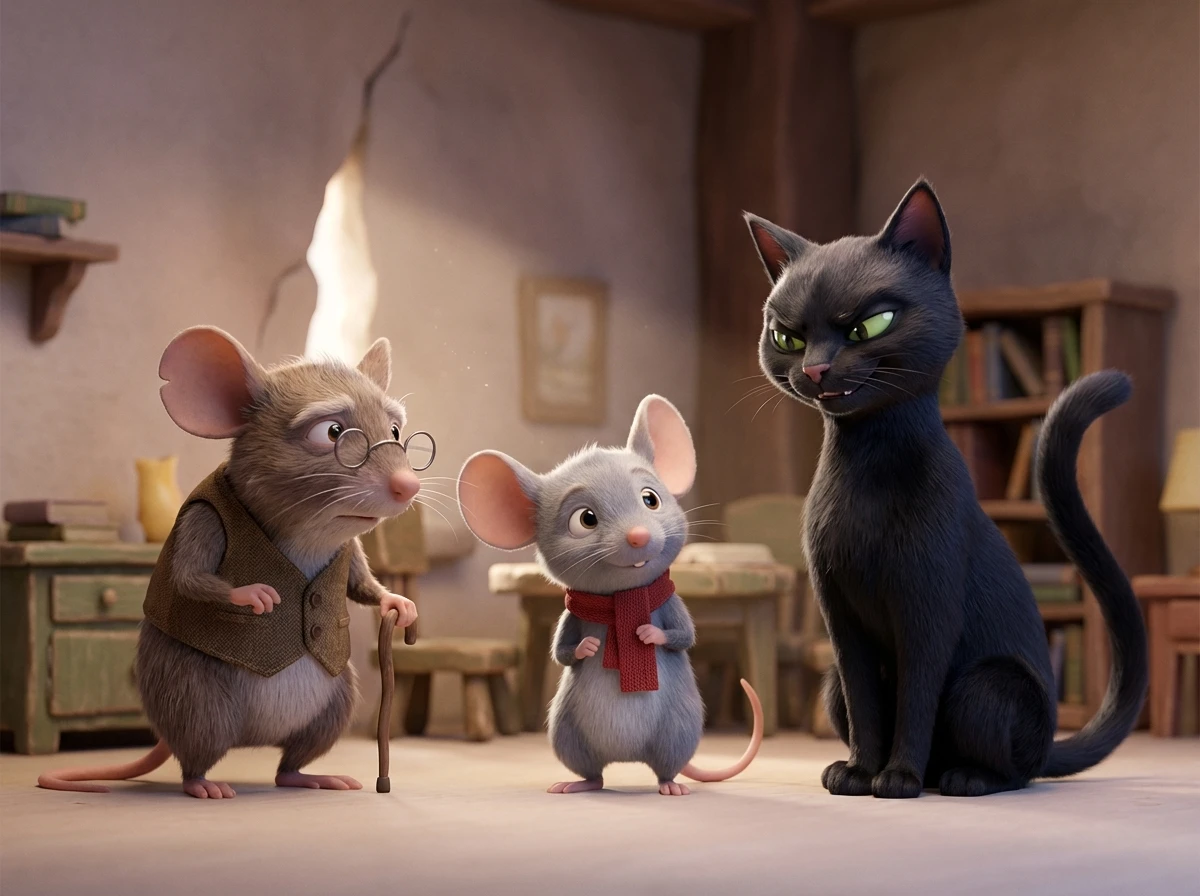
The mice decide to put a bell on the cat, but no one catches the cat.
A council of mice gathers to find a way to outsmart their enemy, the Cat. A young mouse proposes placing a bell around its neck to warn of its approach. The plan is applauded until an old mouse asks the crucial question: who will actually place the bell?
Author: Aesop
Themes: Courage, Planning, Action vs Words
The Mice once called a meeting to decide on a plan to free themselves of their enemy, the Cat. At least they wished to find some way of knowing when she was coming, so they might have time to run away. Indeed, something had to be done, for they lived in such constant fear of her claws that they hardly dared stir from their dens by night or day.
Many plans were discussed, but none of them was thought good enough. At last a very young Mouse got up and said: "I have a plan that seems very simple, but I know it will be successful.
All we have to do is to hang a bell about the Cat's neck. When we hear the bell ringing we will know immediately that our enemy is coming."
All the Mice were much surprised that they had not thought of such a plan before. But in the midst of the rejoicing over their good fortune, an old Mouse arose and said:
"I will say that the plan of the young Mouse is very good. But let me ask one question: Who will bell the Cat?" It is one thing to say that something should be done, but quite a different matter to do it.
Introduction
Belling the Cat is one of Aesop's most famous fables, teaching a timeless lesson about the gap between good ideas and practical execution. This story has been told for centuries to warn against proposing impossible solutions.
About Aesop
Aesop was an Ancient Greek fabulist and storyteller credited with a number of fables now collectively known as Aesop's Fables. Although his existence remains unclear and no writings by him survive, numerous tales credited to him were gathered across the centuries and in many languages.
Values and Lessons
The primary lesson of this story is that it is easy to propose impossible remedies. It teaches children to consider the practicality of their ideas and emphasizes that talking about doing something is very different from actually doing it.
Loading story...
Belling the Cat
Belling the Cat is one of Aesop's most famous fables, teaching a timeless lesson about the gap between good ideas and practical execution. This story has been told for centuries to warn against proposing impossible solutions.
Origins of the Story
This fable is attributed to Aesop, a storyteller believed to have lived in ancient Greece between 620 and 564 BCE. It has become a common idiom in the English language, referring to a difficult task that no one wants to perform.
About Aesop
Aesop was an Ancient Greek fabulist and storyteller credited with a number of fables now collectively known as Aesop's Fables. Although his existence remains unclear and no writings by him survive, numerous tales credited to him were gathered across the centuries and in many languages.
Values and Lessons
The primary lesson of this story is that it is easy to propose impossible remedies. It teaches children to consider the practicality of their ideas and emphasizes that talking about doing something is very different from actually doing it.
Practicality
Courage
Critical Thinking
Action
Let's Discuss
Use these questions to spark a conversation with your child.
🎨Why were the mice afraid of the cat?
💬What was the young mouse's idea?
✨Why did the old mouse ask "Who will bell the cat?"
📝Can you think of a time you had a good idea but it was hard to do?
Frequently Asked Questions
❓What does "Belling the Cat" mean?
It is an idiom that means agreeing to perform a very dangerous or difficult task.
❓Who wrote Belling the Cat?
It is attributed to Aesop, the ancient Greek fabulist.
❓What is the moral of the story?
The moral is that it is easier to say what should be done than to actually do it.